By 2026, the familiar list of ten blue links has largely dissolved into a dynamic, AI-driven canvas. We have transitioned from the Information Age to the Answer Age. In this new paradigm, the primary metric of success for a keyword strategy has shifted from securing a click to earning a citation.
For the modern advertiser, Google Ads is no longer a manual switchboard; it is an autonomous growth engine. The days of granularly managing every bid and single-keyword ad group are behind us. The machine now dominates execution, analyzing millions of data points in real-time to match user intent with advertiser solutions. The human role has fundamentally changed: you are no longer the operator; you are the architect. To navigate this, one must rethink the basics of PPC Keyword Research for an automated world.
This evolution is defined by the convergence of traditional search results, generative AI Overviews (AIO), and the conversational AI Mode. Users effectively treat Google as a dialogue partner, refining queries through natural language. A search for “enterprise software” is no longer a static query but the start of a conversation. If your brand isn’t structured to be the answer that the AI retrieves and cites, you are invisible.
This begs the critical question: In an era of keywordless campaigns and Performance Max, do keywords still matter?
They matter more than ever.
Keywords have evolved from simple matching mechanisms into high-fidelity signals. They are the primary input used to train Google’s AI on your business goals. While the AI decides how to find the user, your keywords dictate who that user should be. They act as the guardrails that prevent the autonomous engine from drifting into irrelevance. Without a precise keyword strategy, you are essentially handing a powerful machine a blank map.
From Keywords to Signals
A signal is a specific data point that algorithms use to understand the true context behind a user’s search. These indicators include real-time variables such as location, device type, and previous browsing history. Advertising platforms analyze these inputs to match the most relevant ad to the right person instantly.
In the legacy era of search, a keyword was a rigid gatekeeper. You bid on “running shoes,” and you showed up for “running shoes.” Today, the keyword is merely a tripwire, a single data point that initiates a cascade of machine learning assessments. To succeed in 2026, you must stop optimizing for strings of text and start optimizing for signals. To understand this nuance, it is critical to revisit the difference between Search Terms vs Keywords, as the gap between what you bid on and what you match to has widened.
Intent Density Over Search Volume
For two decades, High Volume was the holy grail. Marketers chased broad terms like software (100k searches/month) and ignored cloud-based inventory management for SMBs (50 searches/month). In the AI era, this is suicide.
High volume often correlates with low intent and high cost. The new metric is Intent Density: the probability that a specific query signifies an immediate commercial need. AI algorithms now deprioritize generic queries, answering them directly in the AI Overview (AIO) without ever showing an ad. The clicks that remain are on complex, specific queries where the user is looking for a solution, not just information. You are no longer hunting for traffic; you are hunting for qualified friction.
The Hierarchy of Signals
When a user types a query, Google’s AI analyzes thousands of signals in milliseconds. The keyword is just one of them. The modern hierarchy looks like this:
- Contextual Signals: Time of day, device, location, and previous 5 searches.
- Behavioral Signals: Deep historical data on what this user has bought, watched, and clicked over the last year.
- Semantic Signals: The meaning behind the query, not the words themselves.
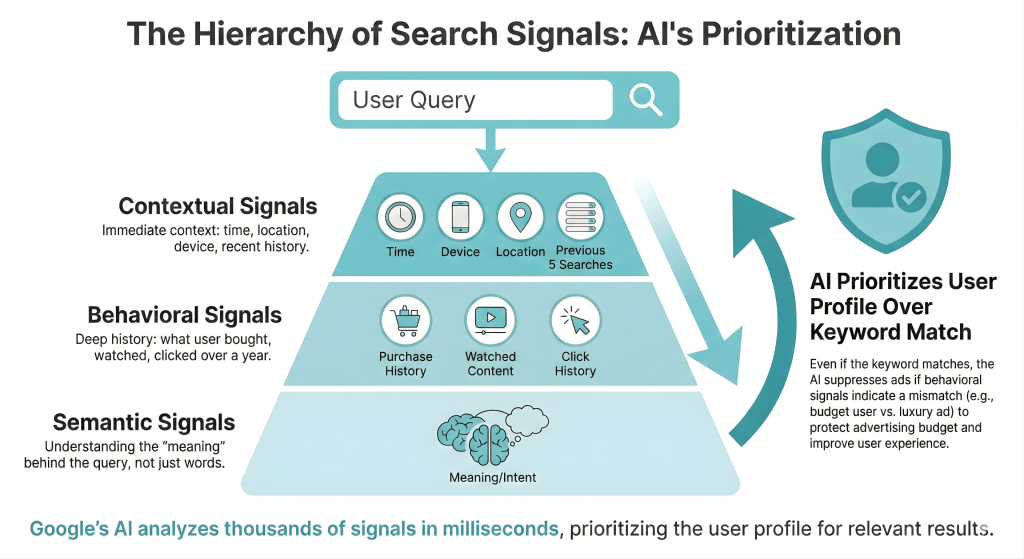
Understanding the different types of keywords available, from informational to transactional, helps you map these signals effectively. If you bid on “luxury hotel,” but the user’s behavioral signal shows a history of budget travel, the AI will suppress your ad to protect your budget, even if the keyword matches perfectly. The algorithm prioritizes the user profile over the keyword match.
First-Party Data
If the machine determines who sees your ad, how do you control it? You cannot bid on a user profile. Instead, you train the machine using First-Party Data.
Your CRM data, which includes encrypted email lists, high-value customer segments, and offline conversion imports, acts as the training manual for the algorithm. By feeding Google a list of your top 1,000 customers, you are effectively saying, “Find more people who look like this, regardless of what keywords they type.” In 2026, a robust Customer Match list is more valuable than a perfect Exact Match keyword. It is the only proprietary advantage you have in an ecosystem where everyone has access to the same automated bidding tools.
The Guide to Match Types
Match types are configuration settings in Google Ads that determine how strictly a user’s search query must match your keyword to trigger an ad. They range from specific matches that require exact wording to broad matches that include related topics and synonyms. Selecting the correct match type allows advertisers to balance the volume of traffic with the relevance of the audience.
For years, match types were syntax rules. Exact meant exact. Broad meant anything vaguely related. In 2026, match types are no longer about syntax; they are about semantic permission. They tell the AI how much freedom it has to interpret the user’s intent. For a refresher on the mechanics, review our Keyword Match Type guide with examples.
The Convergence of Broad and Smart
The Broad Match of 2015 was a blunt instrument, a spray-and-pray tactic that wasted budget on irrelevant synonyms. The Broad Match of 2026 is fundamentally different. It is the only match type that utilizes all available signals: the user’s recent search history, their physical location, landing page context, and competitor activity.
When paired with Smart Bidding (Target CPA or Target ROAS), Broad Match becomes a precision discovery engine. It finds queries you would never think to bid on, like a specific voice command or a complex, natural-language question, and bids only if the conversion probability is high. In 2026, Broad Match is the default setting for scale. It allows the AI to connect the dots between “best running shoes for bad knees” and your keyword “orthopedic footwear.”
The Decline of Phrase Match
Phrase Match has become the awkward middle child of search. It offers neither the reach of Broad Match nor the absolute control of Exact Match.
In the current ecosystem, Phrase Match often actively hinders performance. It restricts the AI from accessing the full signal data available to Broad Match, yet it fails to provide the strict guardrails of Exact Match. As a result, Phrase Match campaigns frequently see higher CPCs (due to less auction liquidity) and lower conversion volume. Unless you have a specific compliance reason to contain word order, Phrase Match is rarely the optimal choice for growth.
Exact Match
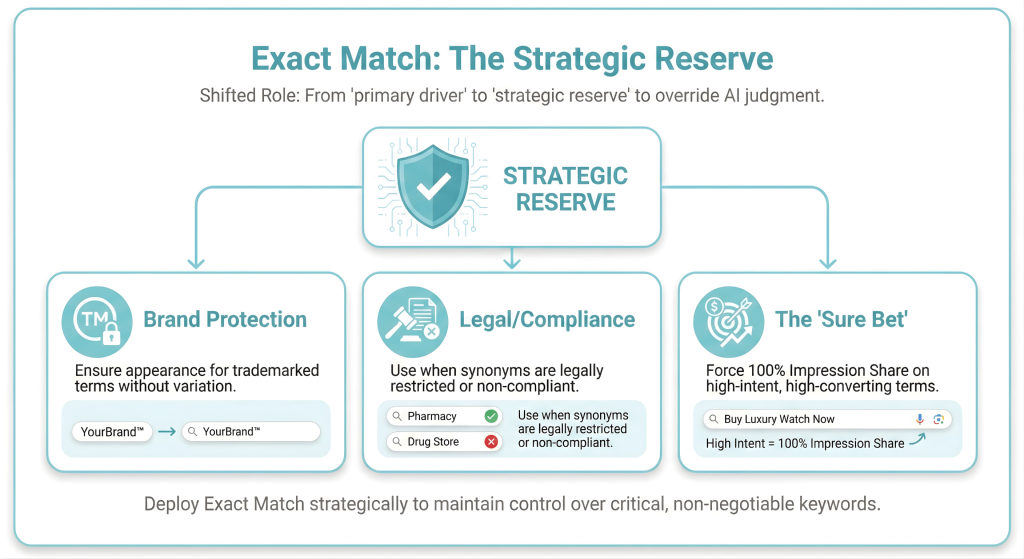
Exact Match has not died, but its role has shifted from primary driver to strategic reserve. You use Exact Match when you need to override the AI’s judgment.
- Brand Protection: Ensure you always appear for your own trademarked terms without variation.
- Legal/Compliance: When you cannot legally appear for a synonym (e.g., “pharmacy” vs. “drug store”).
- The Sure Bet: High-intent, high-converting terms where you want to force 100% Impression Share, regardless of the AI’s efficiency calculation.
Smart Bidding
The most critical realization for 2026 is that match types do not exist in a vacuum. Broad Match requires Smart Bidding. This fundamentally changes what Keyword Bidding is, moving it from a manual auction to an automated value assessment. Without it, Broad Match is dangerous. Smart Bidding acts as the sophisticated filter that decides, “Yes, this query matches the keyword broadly, but this specific user doesn’t fit our conversion profile, so do not bid.” This synergy allows you to cast a wide net (Broad Match) while only pulling up the fish that matter (Smart Bidding).
Step-by-Step Keyword Research
In the past, keyword research was a data-scraping exercise. Today, it is about empathy and intent mapping. Before you begin, run through your keyword research checklist to ensure you are capturing the full scope of user needs.
Stage 1: Audience & Problem Discovery
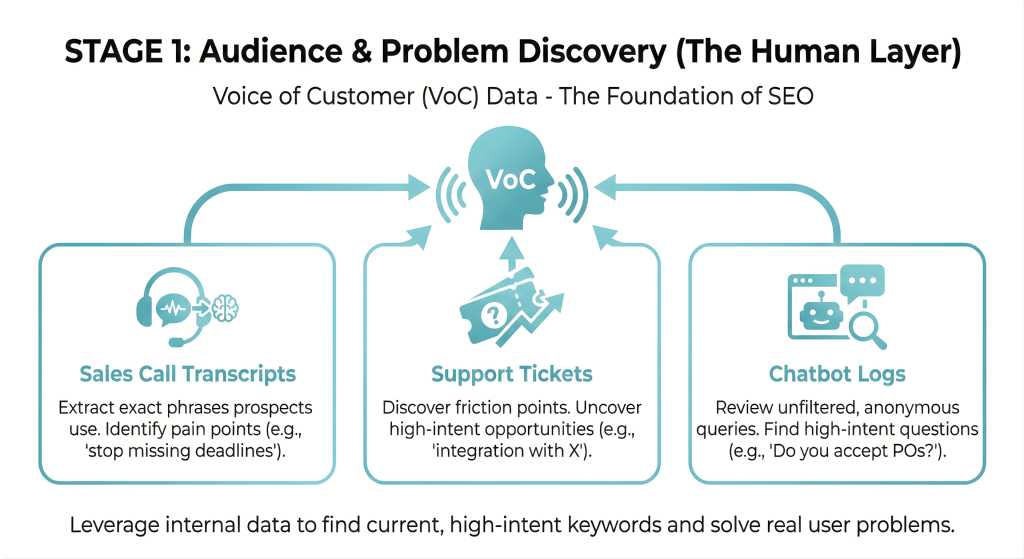
Before opening any tool, you must consult your Voice of Customer (VoC) data. Traditional keyword tools are historical; they show you what people searched for yesterday. Your internal data shows you what people need today.
Analyze three sources:
- Sales Call Transcripts: Use AI summarizers to extract the exact phrases prospects use to describe their pain points. Do they say “project management tool” or “way to stop missing deadlines”?
- Support Tickets: Look for friction points. A surge in tickets about “integration with X” reveals a high-intent keyword opportunity you won’t find in a planner.
- Chatbot Logs: Review anonymous questions users ask your site’s bot. These are often unfiltered, high-intent queries (e.g., “Do you accept purchase orders?”).
Stage 2: Semantic Topic Authority
Google’s algorithms now evaluate Topical Authority. You cannot effectively rank for a single competitive keyword like “CRM” unless you demonstrate expertise across the entire associated topic cluster. This requires a deep understanding of Long Tail Keywords to flesh out your content strategy.
Instead of building a list of 500 disjointed keywords, build Topic Clusters. Knowing how to find Long Tail Keywords is essential here, as these specific queries often form the spokes of your cluster.
- The Hub: The core term (e.g., “Cybersecurity Software”).
- The Spokes: The sub-topics that prove depth (e.g., “ransomware protection,” “endpoint security,” “zero trust architecture”).
By feeding the AI a structured cluster, you signal that you are a credible source for the entire category, which increases your Quality Score and citation probability in AI Overviews.

Stage 3: The Four Stages of Intent
Every keyword must be categorized by intent. This dictates your bidding strategy and ad copy.
- Informational (“How,” “What,” “Why”)
- Example: “How to improve credit score.”
- Strategy: Low intent, high volume. In 2026, avoid bidding here unless you have a massive budget. AI Overviews satisfy these queries directly (Zero-Click searches). If you do bid, push to a lead magnet, not a sales page.
- Navigational (Brand Names)
- Example: “Salesforce login,” “HubSpot pricing.”
- Strategy: Understanding the split between Branded vs Non-Branded Keywords is vital here. Bid on your own brand to protect your territory.
- Commercial Investigation (“Best,” “Vs,” “Review”)
- Example: “Best CRM for real estate 2026,” “Asana vs. Monday.”
- Strategy: The Battleground. These users are problem-aware and solution-aware but undecided. This is where you deploy comparison pages and case studies. Intent density is high here; be aggressive with bids.
- Transactional (“Buy,” “Demo,” “Quote,” “Cheap”)
- Example: “Buy project management software,” “Plumber near me.”
- Strategy: The Gold Standard. These are your Bottom of Funnel Keywords. These users have a credit card in hand. For limited budgets, 100% of the spend should go here. Use Exact Match and maximize impression share.
Stage 4: Modern Toolkits
The Google Keyword Planner has evolved into a predictive engine. Mastering how to use Google Keyword Planner is now about forecasting rather than just history.
- Forecasting Over History: Don’t just look at “Avg. Monthly Searches.” Use the Forecast tool to see estimated conversion volume based on your specific bid strategy.
- Gemini Integration: Use the integrated AI to generate Semantic Cousins. If you sell “running shoes,” ask the planner for “activities related to marathon training.” It might suggest “energy gels” or “anti-chafe balm”, keywords that imply the persona of a runner without competing for the expensive “shoe” keyword.
- Competitor Analysis: You must know how to find and analyze Competitor Keywords to spot gaps in their strategy that you can exploit.
- Assess Difficulty: Don’t just chase volume; analyze Keyword Difficulty to ensure you can actually compete for the impression.
- Low Competition Gems: Use AI tools to identify gaps; knowing how to find Low Competition Keywords is often the key to high ROI in saturated markets.
Structuring Your Account for Machine Learning
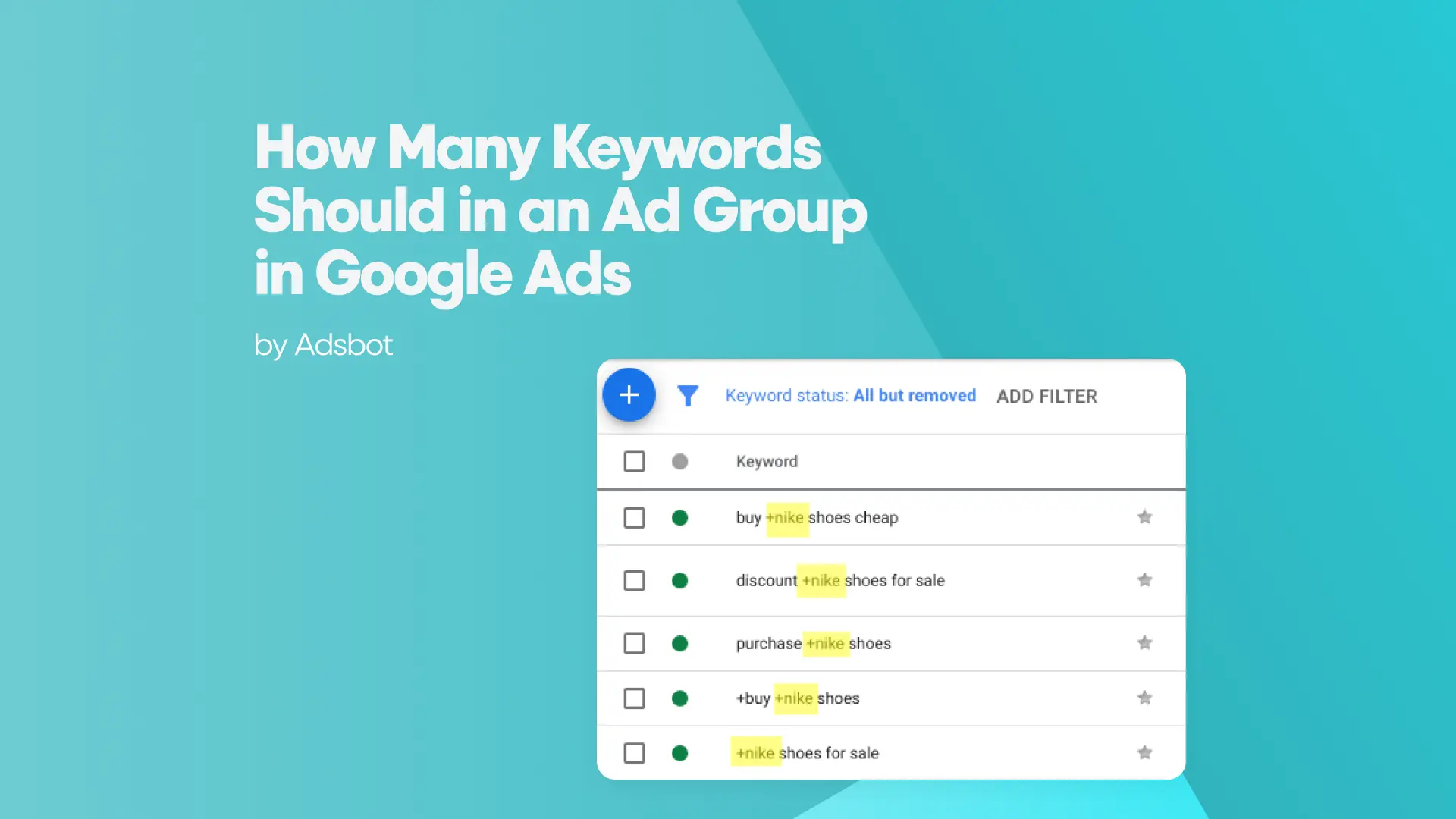
For over a decade, the gold standard of account structure was hyper-granularity. A common question was “How Many Keywords Should Be in an Ad Group in Google Ads?” We built SKAGs (Single Keyword Ad Groups) to force total control. In 2026, this structure is a liability.
The core principle of modern account structure is Data Density. Smart Bidding algorithms crave volume. They need hundreds of conversions per month to identify patterns and predict user behavior efficiently. When you fragment your account into 500 micro-ad groups, you dilute the data, starving the AI. You are essentially hiding the forest from the algorithm by forcing it to look at one tree at a time.
The Hagakure Method
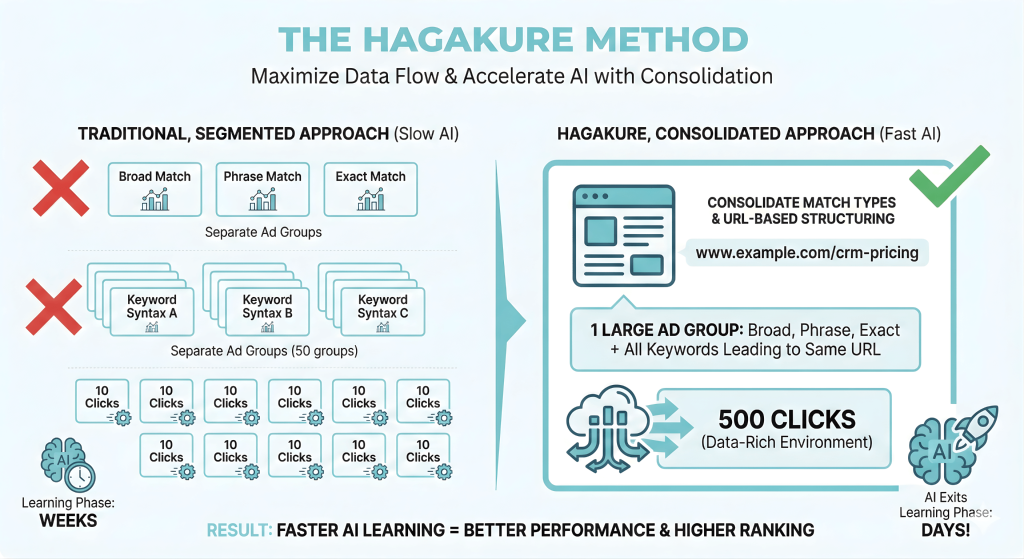
The industry has converged on a consolidation strategy often called the Hagakure method. The goal is to maximize the data flowing into each campaign. Once you understand how to add keywords to Google Ads correctly in bulk, you should structure them by landing page rather than syntax.
- Consolidate Match Types: Do not split Broad, Phrase, and Exact into separate ad groups. Group them together so the algorithm can share learnings across match types.
- URL-Based Structuring: Instead of grouping by keyword syntax, group by landing page. If 50 keywords all lead to the same “CRM Pricing” page, they belong in the same ad group.
- The Result: Instead of 50 ad groups with 10 clicks each, you have 1 ad group with 500 clicks. This allows the AI to exit the Learning Phase in days rather than weeks.
- Clean Hygiene: Regular maintenance is key. Use a Duplicate Keyword Remover to ensure you aren’t bidding against yourself in different campaigns.
The Tight Structure Rule
How do you know when to split an ad group? Use the Tight Structure Rule:
- Only create a new ad group if you need to write a meaningfully different ad.
If you are bidding on “red running shoes” and “blue running shoes,” you need separate ad groups because the user expects to see the specific color in the headline. However, if you are bidding on “buy running shoes” and “purchase running shoes,” the intent is identical. Splitting them adds complexity without adding relevance. Consolidate them.
The Performance Power Pack
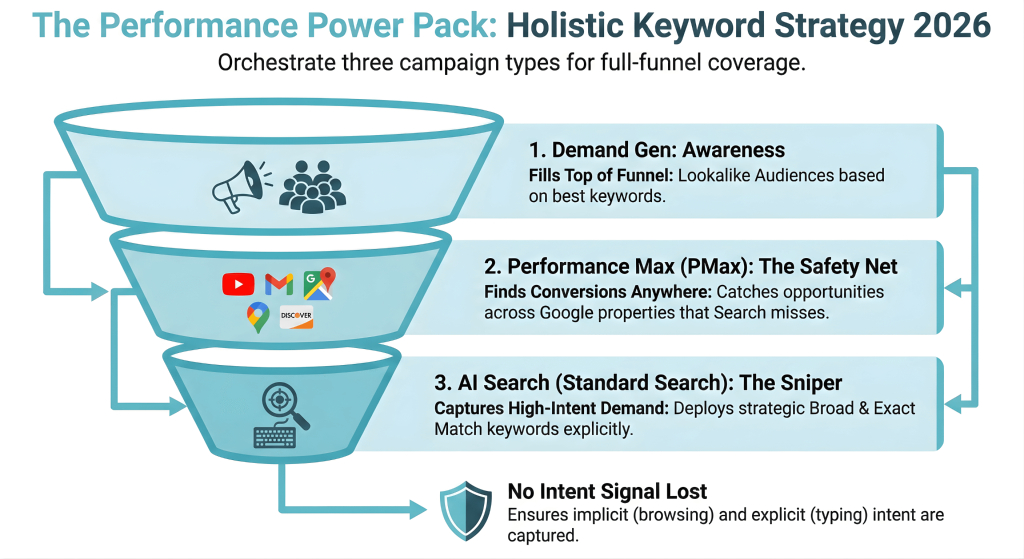
Your search campaigns do not live in isolation. In 2026, a holistic keyword strategy requires orchestrating three distinct campaign types to cover the full funnel:
- Demand Gen: Creates awareness. You target lookalike audiences based on your best keywords. This fills the top of the funnel.
- Performance Max (PMax): The safety net. It finds conversions across YouTube, Gmail, Maps, and Discover that your Search keywords miss.
- AI Search (Standard Search): The sniper. This is where you deploy your strategic Broad Match and Exact Match keywords to capture high-intent demand explicitly.
By aligning these three, you ensure that no intent signal, whether implicit (browsing behavior) or explicit (typing a keyword), is lost.
Optimizing Keywords for AI Overviews (AIO) and Agents
AI Overviews are automated summaries that appear at the top of Google search results to answer questions directly. This feature uses artificial intelligence to combine information from different websites into a single, easy-to-read explanation. Instead of clicking on several links, users get a complete answer instantly within the search page itself.
The most disruptive change in 2026 is the visual dominance of AI Overviews (AIO). When a user asks a question, Google’s AI now synthesizes a zero-click answer. If you are not the source of this answer, you do not exist. To win here, you must move beyond Search Engine Optimization (SEO) to Answer Engine Optimization (AEO). Learning how to optimize keywords in Google Ads now means optimizing for this answer engine (AEO).
The Shift from Indexing to Training
Traditional SEO was about proving relevance to a crawler. AEO is about proving logic to a model. AI models are probabilistic engines; they predict the next most likely word based on their training data. To become a citation, your content must be structured in a way that makes it the path of least resistance for the AI to retrieve.
Answer-First Formatting
To increase your citation odds, you must adopt Answer-First formatting. AI models struggle to extract facts from 2,000 words of fluff. They prefer the BLUF (Bottom Line Up Front) method.
- The Structure: Immediately follow a heading with a 40-60 word direct definition or answer.
- The Nuance: Follow the direct answer with bullet points or data tables.
- The Benefit: This snippet acts as a handle for the AI to grab. If someone asks, “What is the best CRM for small businesses?” and your page starts with a direct, concise paragraph answering exactly that, you drastically increase your chance of being the featured citation.
Business-to-Robot Marketing
We are entering the age of Agentic AI, where personal AI assistants (Agents) will shop on behalf of humans. A user might tell their agent, “Find me a project management tool under $50/month with Gantt charts and API access.”
The Agent does not care about your brand’s story. It scans for Structured Data.
- Logic over Emotion: Agents look for specs, pricing tables, and feature lists. Ensure your product pages utilize clear HTML tables and comparison charts that agents can parse easily.
- JSON-LD Supremacy: You must implement deep Schema markup (Organization, Product, FAQPage) to explicitly tell the Agent, “This is the price,” “This is the stock status,” and “This is the feature list.” If the Agent has to guess your pricing, it will skip you.
The llms.txt Standard
Just as robots.txt tells crawlers where they can go, the llms.txt file has become the standard for guiding Large Language Models. This file, placed in your root directory, points AI crawlers to a simplified, markdown-only version of your most important content. By providing a clean, code-free version of your site specifically for training data, you ensure the AI understands your business without the noise of JavaScript, pop-ups, and CSS. This is the ultimate signal of AEO maturity in 2026.
Conversational & Multimodal Keywords
Conversational and multimodal keywords are search inputs that utilize natural spoken language and visual imagery alongside traditional text to convey user intent. These queries prioritize complete sentences and contextual data over fragmented keywords, mirroring human-to-human dialogue. By integrating voice and visual signals, they allow search engines to interpret complex requests more accurately than text alone.
By 2026, the keyboard is no longer the sole input device. With the maturation of voice assistants and visual search tools like Google Lens, search behavior has become multimodal. Users don’t just type; they talk, snap photos, and circle objects on their screens. Your keyword strategy must adapt to these new inputs.
Voice Search Survival
Voice search has finally surpassed the tipping point, accounting for over 50% of mobile queries. The critical shift here is syntax. When typing, a user enters “weather Paris.” When speaking, they ask, “What is the weather like in Paris this weekend?” This shift to natural language requires a Long-Tail Conversational Strategy. You must bid on full sentence structures or, more efficiently, use Broad Match to capture the intent behind the sentence.
Identify the Trigger Questions your customers ask (e.g., “Why is my…?”, “How do I fix…?”) and ensure your ad copy mirrors that conversational tone. A formal headline feels robotic in a voice-first world; a conversational headline feels like a helpful answer. While ad copy needs to be conversational, using Keyword Insertion can help you dynamically match the user’s specific query to your headline.
Multimodal Exploration
Circle to Search and Google Lens have turned images into queries. If a user snaps a photo of a red sneaker and searches “buy this,” there is no text keyword to bid on. The image itself is the keyword. To capture this traffic, you must treat your visual assets as data.
- Descriptive Alt-Text: Stop using generic filenames like IMG_001.jpg. Use red-running-shoe-breathable-mesh-size-10.jpg.
- Merchant Center Metadata: Ensure your product feed attributes (color, pattern, material) are exhaustive. The AI uses this structured data to match your product to the pixels in the user’s photo.
Intent Refinement
Perhaps the most profound change is Intent Refinement within Google’s conversational AI Mode. Users often start with a vague query like “camping gear.” The AI then asks, “Where are you going?” and “What time of year?” The user does not see ads until they have refined their intent. This means the ad auction happens later in the journey, but with significantly higher conversion probability. Your strategy is not to win the broad “camping gear” search, but to be the hyper-relevant answer for “lightweight tent for rainy season” that appears after the AI helps the user clarify their needs.
Negative Keywords
Negative keywords are specific words or phrases that prevent your ad from showing when they are included in a user’s search query. By adding these terms to your campaign, you ensure that your advertising budget is not wasted on irrelevant searches that are unlikely to convert. This tool allows advertisers to filter out unwanted traffic and focus their spending on high-quality, relevant prospects.
In a Google Ads ecosystem increasingly defined by black box automation and Broad Match expansion, negative keywords have evolved from a simple optimization tactic into your most critical strategic safeguard. They are the only definitive “No” you can give to the machine. While Smart Bidding decides what to bid on, negative keywords are the manual override that defines where your brand refuses to go.
Reclaiming Control in Performance Max
For early adopters, Performance Max (PMax) felt like a vehicle with no brakes. That era is ending. Marketers now have the power to apply Account-Level Negative Keyword Lists that universally block traffic across Search, Shopping, and PMax simultaneously. Crucially, the native interface now supports up to 10,000 negative keywords per campaign. This allows you to aggressively filter out low-value variations without needing to contact a Google representative for backend exclusions. You can now build sophisticated firewalls against irrelevant traffic.
Automated Mining and Self-Cleaning Accounts
With Broad Match casting a wider net, manual search term mining is no longer feasible. You cannot review 20,000 queries a month by hand. The solution is script-based automation. Modern strategists use Google Ads Scripts to automatically mine search query reports. You can program logic such as: “If a search term contains ‘free’, ‘job’, or ‘template’ and has accumulated 50 impressions with zero conversions, automatically add it to the Shared Negative List.” This turns your account into a self-pruning garden, where the weeds are removed the moment they sprout, keeping your Smart Bidding algorithm focused exclusively on high-intent signals.
Brand Integrity
Finally, negative keywords are the guardians of brand equity. In an AI-first world, appearing against the wrong query can damage trust. You must maintain rigorous No-Go lists.
- Competitor Exclusion: If you have historically low Quality Scores on specific competitor terms, exclude them. Don’t let the AI waste budget fighting battles you can’t win.
- Contextual Safety: As news cycles move faster, use negative keywords to preemptively block sensitive or tragic terms to ensure your ads never appear in brand-unsafe environments.

Advanced ROI Strategies
The most brilliant keyword strategy will fail if the underlying data is flawed. In 2026, the Identity Economy has replaced the Cookie Economy. The foundation of keyword performance is no longer the bid; it is the integrity of the signal feeding that bid.
The Identity Economy
With third-party cookies fully deprecated, relying on browser-based pixels is a guaranteed way to lose 30% of your conversion data. The new standard is Server-Side Tagging via Google Tag Gateway. You must implement the AW-tag (Google’s native tag) directly on your server. This bypasses browser restrictions and ensures that when a user converts, the signal is sent securely and instantly to Google Ads. If you are still relying on a simple JavaScript pixel, you are feeding the AI incomplete data, which forces it to bid conservatively. In the Identity Economy, the advertiser with the best data, not the highest bid, wins the auction.
Value-Based Bidding
Maximize Conversions is often a trap. It incentivizes the AI to find the cheapest possible conversions, which are often low-value users or support seekers. In 2026, you must graduate to Value-Based Bidding (VBB). VBB requires you to pass dynamic values back to Google Ads. Do not just track a “Lead”; track “Lead – Enterprise – $5,000 Potential Value.” By training the AI on potential revenue (margin) rather than just volume, you teach it to ignore cheap clicks and aggressively bid on expensive keywords that drive high Lifetime Value (LTV). You are effectively telling the machine: “I don’t care if the CPA is high, as long as the ROAS is higher.”
Validating the Lift
In a multi-touch world, Last Click attribution is a lie. It gives all the credit to the branded keyword the user typed right before buying, ignoring the generic keywords that introduced them to the brand weeks earlier. To validate if your generic keywords are truly driving growth, you must use Incrementality Testing and Marketing Mix Modeling (MMM).
- Geo-Lift Experiments: turn off generic keywords in one state (e.g., Ohio) and keep them on in another (e.g., Pennsylvania). Measure the difference in total revenue, not just ad revenue.
- MMM: uses statistical regression to reveal the halo effect of your search spend on direct traffic. This math proves that your expensive top-of-funnel keywords are actually the engine driving your cheap bottom-of-funnel conversions.
The Future of the Search Professional
The era of the keyword operator is over. In 2026, the search professional is a strategist, a pilot who trains the autopilot rather than pulling every lever. Your value no longer lies in manual bid adjustments, but in the quality of the signals (First-Party Data) and the clarity of the destination (Value-Based Bidding) you provide to the AI.
To survive this shift, your immediate action plan is clear:
- Audit: Remove fragmented SKAG structures and consolidate into broad, data-dense themes.
- Restructure: Implement the Hagakure method to feed Smart Bidding the volume it craves.
- Prepare: Rewrite core content with Answer-First formatting for AI Overviews.
Think of your Google Ads account not as a library where you manually file every book, but as a sophisticated GPS. You don’t need to shout every turn. You simply input a precise destination (profit goals) and ensure the tank is full of high-quality fuel (customer data). Your job is to stay in the driver’s seat to oversee the route and steer away from the cliff edge (negative keywords). The machine drives; you navigate.
Frequently Asked Questions (FAQ)
How many keywords are good for Google Ads?
In the era of AI and Smart Bidding, the focus has shifted from quantity to data density. Instead of creating hundreds of single-keyword ad groups, focus on fewer, consolidated ad groups centered around a specific URL or theme. A healthy ad group contains 5-20 broadly related keywords that drive enough volume for the machine learning algorithms to optimize effectively.
How to pick keywords for Google Ads?
Start with Audience Discovery rather than tools. Analyze your sales transcripts, support tickets, and chatbot logs to find the natural language your customers use. Filter these candidates by Intent Density, prioritizing specific, problem-solving queries over high-volume generic terms. Finally, validate them using the Keyword Planner’s forecasting tools.
How do I identify my keywords?
Identify keywords by mapping your customer’s journey. Use Topic Clusters to establish authority: identify a core “Hub” term (e.g., “CRM Software”) and build Spoke keywords around it (e.g., “CRM for small business,” “CRM pricing”). Ensure every keyword is categorized by intent: Informational, Navigational, Commercial, or Transactional.
Author:

Get 3x more revenue from the same ad spend.
Let our onboarding experts show you the power of AI-driven PPC optimization.
Start scaling today
Popular Posts
-
 How Many Keywords Should Be In an Ad Group in Google Ads?
For the vast majority of modern campaigns, the ideal number…
Read more -
 Google Ads Script for Dummies: An Introduction
Imagine you have an e-commerce website that sells licensed superhero…
Read more -
Google Ads Sitelink Character Limits
Your Google Ads are cutting off in the middle of…
Read more -
What Is Conversion Value in Google Ads?
What if you could put a price tag on every…
Read more

Register for our Free 14-day Trial now!
No credit card required, cancel anytime.