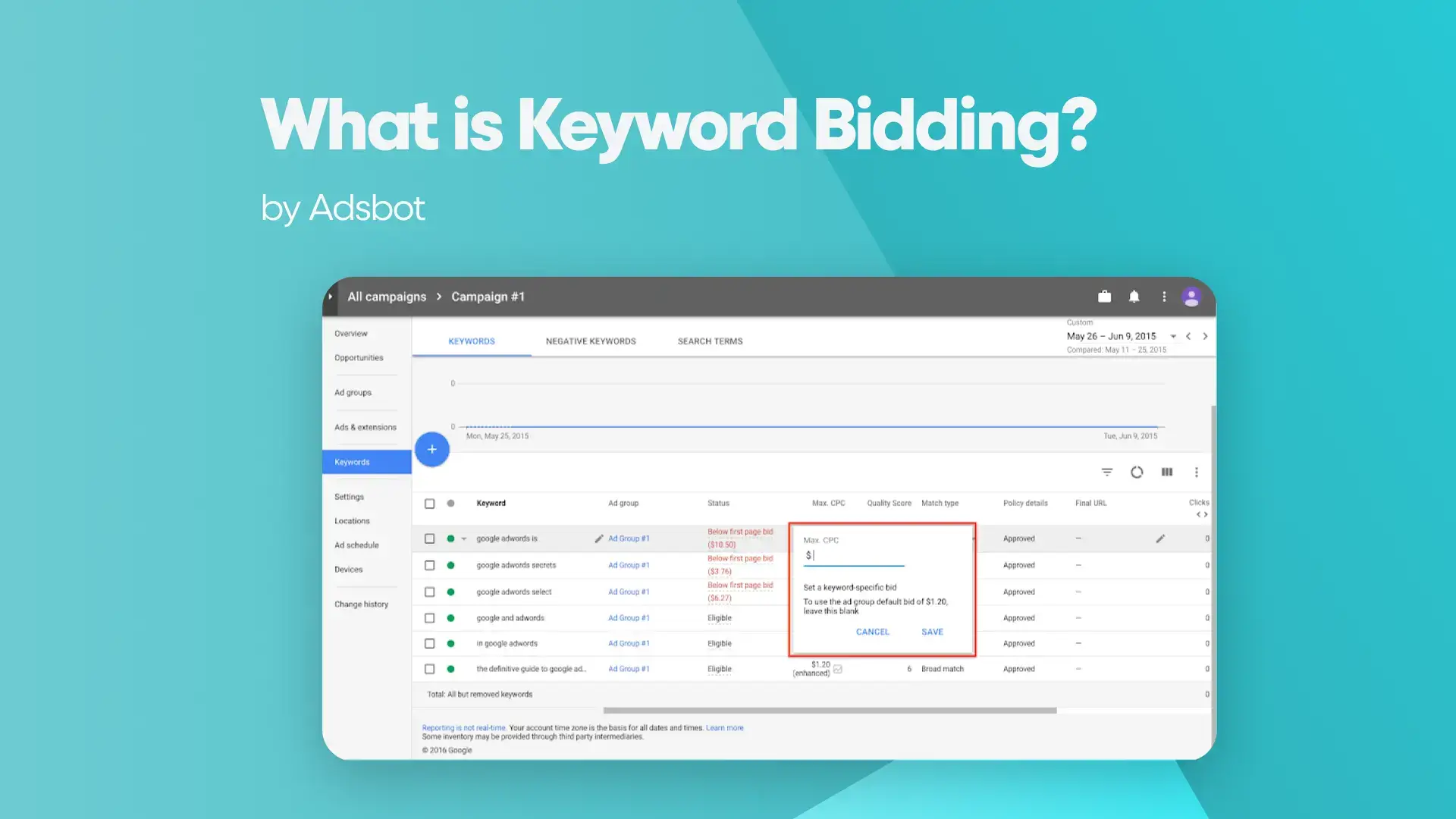
Keyword bidding is a digital advertising process where advertisers specify the maximum amount they are willing to pay for a click on a specific search term. This bid enters an automated auction that determines whether an ad is displayed and its position relative to competitors on the search results page. It functions as a primary control mechanism, allowing businesses to balance their budget against the need for visibility to potential customers.
The era of paying for literal character matches is effectively over.
Keyword bidding has evolved from a deterministic exercise into algorithmic prediction. Keywords are no longer rigid targets; they now function merely as anchors or seeds for machine learning models. When a query is entered, AI synthesizes millions of real-time signals, including location, device, operating system, and conversational syntax, to determine relevance in milliseconds.
This transition from matching character strings to predicting high-dimensional intent signals demands a fundamental strategic pivot. Success no longer depends on managing exhaustive keyword lists, but on curating high-quality first-party data. This data trains the algorithms to distinguish between a curious browser and a profitable customer.
To dominate modern search auctions, you must move beyond the basics found in The Google Ads Keyword Guide and accept that you are no longer a bid manager, but a data architect for an automated system.
How does the Search Auction Work?
A search auction is an automated process that determines which ads appear on a search engine results page and in what order. It occurs instantly every time a user enters a search query, evaluating advertisers’ bids and the quality of their ads. The goal is to show users the most relevant advertisements while maximizing revenue for the search platform.
Many advertisers mistakenly believe the Google Search auction operates on a simple highest bidder wins model. In reality, it is a second-price auction modified by relevance, designed to balance advertiser revenue with user experience.
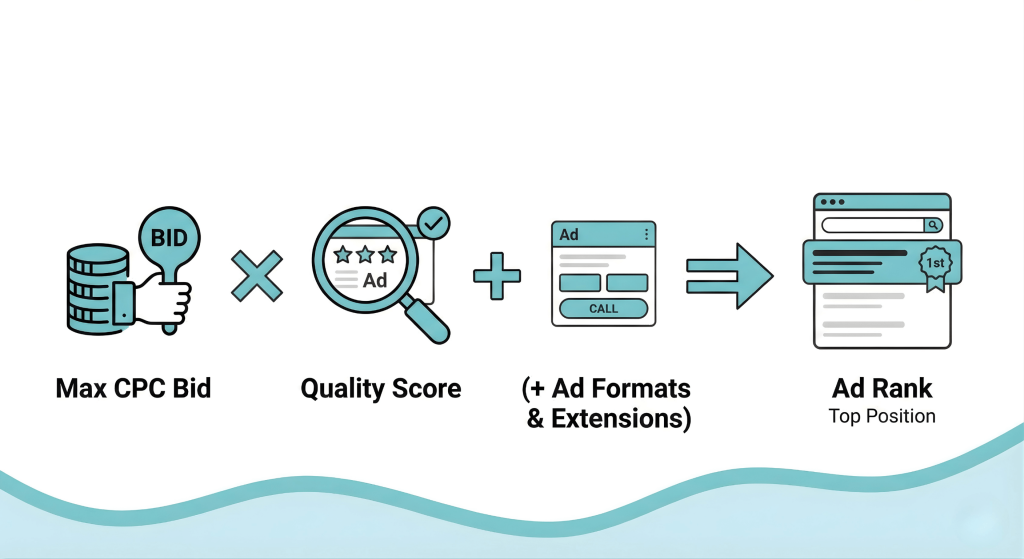
Winning a placement depends on your Ad Rank, a metric calculated in real-time for every query. Ad Rank is not solely determined by your maximum bid. Instead, it follows a specific formula:
Ad Rank = Max CPC Bid × Quality Score (+ Ad Formats/Extensions)
This formula ensures that deep pockets cannot simply buy their way to the top with irrelevant ads. A lower bidder with a high Quality Score can often outrank a higher bidder with poor relevance, while paying less per click.
What is the Quality Score Multiplier?
The Quality Score multiplier is a component of the ad auction that adjusts your bid’s effectiveness based on the relevance of your ad. It allows high-quality ads to achieve better placement on the search results page, often at a lower cost than competitors. This factor ensures that the auction prioritizes user experience over simply the highest monetary bid.
Quality Score (1-10) is the engine of efficiency. It comprises three core components:
- Expected Click-Through Rate (CTR): The likelihood a user will click your ad based on historical performance.
- Ad Relevance: How closely your ad copy matches the user’s intent.
- Landing Page Experience: The speed, relevance, and transparency of the page the user lands on.
The Pricing Mechanism
Your actual Cost-Per-Click (CPC) is rarely your maximum bid. You pay the minimum amount required to maintain your position above the next competitor. The formula is:
Your Price = (Ad Rank of the Advertiser Below You / Your Quality Score) + $0.01
High Quality Scores act as a discount mechanism, effectively subsidizing your traffic costs. Conversely, low scores act as a tax, forcing you to overpay for the same visibility.
However, high bids don’t guarantee success if the competition is too fierce. Assessing Keyword Difficulty allows you to identify reachable targets where your budget can actually compete for visibility rather than being drained by expensive, high-competition terms.
Manual Bidding vs. Smart Bidding
Manual bidding creates a fixed limit on what an advertiser pays for a click, offering control but lacking flexibility during live auctions. Smart bidding uses machine learning to automatically change bids in real-time based on the probability of a sale. This automation helps advertisers get better results by analyzing user data like location and device instantly.
Understanding the math behind Ad Rank is crucial, but calculating it manually for every query is impossible. This realization has driven a massive industry shift: over 80% of Google advertisers have abandoned manual controls in favor of automation. The evolution of bidding models reflects a move from control to performance.
Manual Bidding
Manual CPC offers the illusion of control. You set a static maximum price for a keyword, which remains constant regardless of the user’s specific context. While useful for granular control in brand campaigns, it is inherently reactive. Manual bidders optimize based on past data, often adjusting bids days or weeks after a trend has shifted, leaving them vulnerable to competitors using real-time algorithms.
This control is particularly relevant when managing brand reputation. Distinguishing between Branded vs. Non-Branded Keywords allows for distinct bidding strategies: protecting your brand equity with aggressive manual bids while using automated smart bidding to capture broader, non-branded discovery traffic.
Smart Bidding
Smart Bidding differs from basic automation. While standard automated bidding might simply aim to maximize clicks, Smart Bidding utilizes auction-time bidding. This machine learning technology sets a unique bid for every single auction, factoring in millions of signals, including device, location, time of day, and operating system, to predict the precise probability of a conversion.
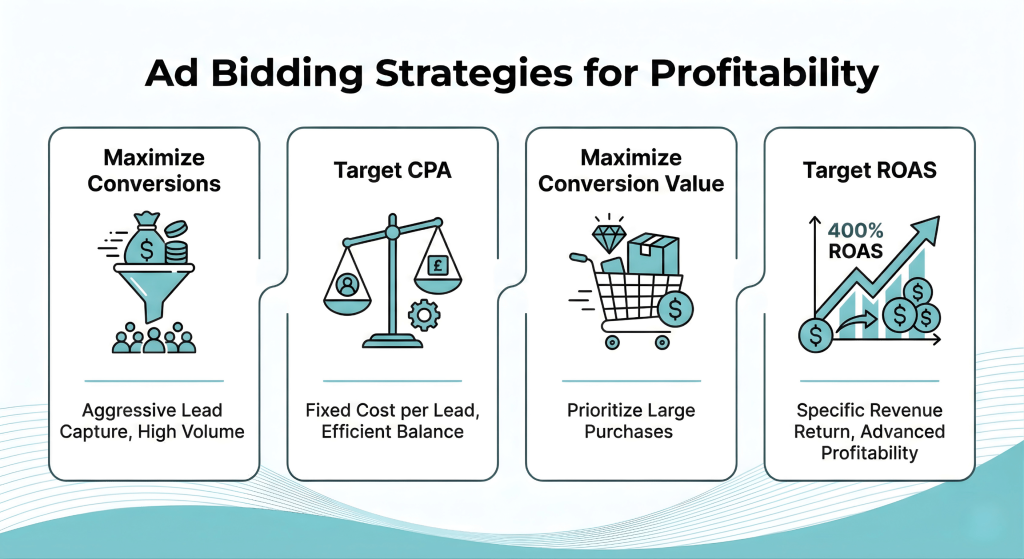
To harness this power, advertisers generally deploy one of four core strategies:
- Maximize Conversions: Aggressively spends the daily budget to capture the highest volume of leads, ideal for scaling new campaigns with limited data.
- Target CPA (Cost Per Action): Balances volume with efficiency, aiming to acquire customers at a fixed cost. This is the standard for lead generation.
- Maximize Conversion Value: Shifts the focus from how many to how much, prioritizing users likely to make larger purchases.
- Target ROAS (Return on Ad Spend): The most advanced profitability lever, instructing the AI to deliver a specific revenue return (e.g., 400%) for every dollar invested.
This evolution marks a fundamental change in the advertiser’s role: you are no longer inputting bid prices, but guiding the algorithm toward profitable outcomes.
Value-Based Bidding (VBB)
Value-based bidding is an automated strategy that optimizes bids to maximize the total value of conversions rather than the quantity. It analyzes data to predict the potential revenue from a user and increases bids for those likely to spend more. This ensures that the advertising budget is prioritized for high-value customers who contribute most to business profit.
While Smart Bidding automates the how of bidding, Value-Based Bidding (VBB) refines the why. Standard automation has a critical blind spot: it often treats every conversion as equal. To an algorithm running a basic strategy, a curious window shopper downloading a free whitepaper is identical to a CEO requesting an enterprise demo. VBB fixes this by teaching the AI to distinguish between volume and value.
How to Profit?
The shift to VBB transforms digital marketing from a cost center into a profit engine. Instead of asking, “How many leads can we get for $50?”, VBB asks, “How much revenue can we generate for every $1 invested?” This strategy compels the bidding algorithm to deprioritize low-quality clicks, even if they are cheap, and aggressively bid on users who exhibit high-value signals, such as repeat purchase behavior or high lifetime value potential.
To maximize returns, focus your budget on users closest to a purchasing decision. Integrating Bottom of Funnel Keywords into your strategy ensures you are capturing high-intent traffic that is most likely to convert into revenue.
Teaching the Algorithm with Proxy Values
For e-commerce, value is transparent: it’s the cart total. However, for lead generation and B2B, the path is complex. This is where proxy values become essential. Advertisers must assign static monetary values to specific conversion actions based on operational data.
- Marketing Qualified Lead (MQL): might be assigned a value of $100.
- Sales Qualified Lead (SQL): might be assigned a value of $900.
- Closed Deal: might be assigned a value of $5,000.
By feeding these values back into the system, you effectively tell the Smart Bidding algorithm: “I am willing to pay 9x more for a user likely to become an SQL than for a mere form filler.” The system then adjusts bids in real-time, focusing the budget on the specific intent signals that drive actual business revenue rather than vanity metrics.
What are AI Max and Performance Max?
With Value-Based Bidding establishing what creates profit, the next step is empowering the algorithm to find it. This requires a shift to the Power Pack strategy: combining broad match keywords with Smart Bidding.
AI Max
AI Max refers to using artificial intelligence in search campaigns to automatically identify and bid on relevant queries. It combines Broad Match keywords with Smart Bidding to capture valuable traffic that rigid keyword lists often miss. This approach allows advertisers to reach new customers based on their intent and behavior rather than just the specific words they type.
The most significant recent change is the functional broad-matchification of search. In the past, Exact Match meant strict adherence to a specific string. Today, even Exact and Phrase match types incorporate semantic signals. However, Broad Match has evolved into a sophisticated AI Max tool.
Modern Broad Match no longer just guesses synonyms. It acts as a keywordless technology. It treats your keyword not as a constraint, but as an intent anchor. If you bid on “running shoes,” the AI doesn’t just look for those words; it analyzes the user’s search history, recent location, and landing page context to match queries like “training for a marathon” or “best footwear for 5k.” It captures the unpredicted relevant queries that rigid match types miss, effectively acting as a prospecting engine.
Performance Max (PMax)
If Broad Match captures intent on Search, Performance Max (PMax) captures it everywhere else. PMax is a goal-based campaign type that accesses all of Google’s inventory, YouTube, Display, Search, Discover, Gmail, and Maps, from a single campaign.
Initially criticized as a Black Box, PMax has matured. Advertisers now have access to channel-level reporting and granular asset insights, allowing for strategic steering. PMax complements keyword-based search by finding users who aren’t actively searching but are displaying high-intent signals consistent with your high-value customers.
Smart Bidding Exploration
Smart bidding exploration is an automated process where the algorithm tests new search queries to find untapped conversion opportunities. It intentionally bids on unproven traffic to gather data and learn if specific segments can become profitable. This continuous testing helps campaigns expand their reach and discover new customers beyond historical patterns.
To make this work, the algorithms engage in exploration. Occasionally, you may see the AI bid on seemingly lower-intent traffic or temporarily miss a ROAS target. This is not an error; it is a calculation. The system deliberately tests new traffic segments to verify if they yield profitable conversions. It sacrifices immediate efficiency for long-term data expansion, ensuring your campaigns don’t plateau by fishing in the same depleted pond.
Privacy and Measurement
Smart Bidding and AI Max are powerful engines, but they require fuel: high-quality data. In a privacy-first world where third-party cookies are crumbling, the old methods of tracking user behavior are obsolete. To maintain the accuracy required for algorithmic bidding, you must rebuild your technical foundation.
The collapse of third-party cookies means browsers are increasingly blind to user activity. If your bidding algorithm cannot see the conversion, it cannot optimize for it. The solution lies in owning your data architecture through Enhanced Conversions. This feature allows you to capture first-party data, such as email addresses or phone numbers, at the point of conversion, hash it for privacy, and securely match it back to ad clicks. This restores the visibility lost to browser restrictions.
To further harden your data pipeline, you must move beyond client-side tracking. Google Tag Gateway (server-side tagging) shifts the burden of measurement from the user’s browser to your own server. By serving tags from a first-party domain, you bypass many ad blockers and browser tracking preventions. Early adopters of this server-side approach often see conversion uplifts of up to 14%, simply by recovering data that was previously blocked.
Finally, ensure your site utilizes the modern AW-tag. Legacy conversion linkers fail in restricted environments (like iOS). The AW-tag ensures that click identifiers (gclid) follow the user across domains, preserving the critical link between the ad click and the final sale. Without this technical hygiene, your Smart Bidding is flying blind.
How is The E-E-A-T Important for Google Ads?
While technical hygiene ensures the algorithm can see the conversion, only high-quality content ensures the user actually completes it. Modern bidding algorithms do not operate in a vacuum; they are intrinsically linked to the relevance of your creative assets. You cannot out-bid a bad user experience.
This is where Google’s E-E-A-T (Experience, Expertise, Authoritativeness, Trustworthiness) framework intersects with auction mechanics. The algorithm prioritizes ads that deliver immediate value and demonstrate expertise.
Ad Strength as a Ranking Signal
Ad Strength serves as a diagnostic tool that measures the relevance and diversity of your ad copy. It evaluates whether your headlines and descriptions provide enough variety for Google’s machine learning to optimize performance. A higher score directly improves your ad’s ability to enter more auctions and secure better placement.
Many advertisers dismiss Ad Strength ratings as cosmetic. This is a costly error. Ad Strength is a direct feedback loop from the auction algorithm, indicating how well your assets match diverse user intents. Moving an ad from Poor to Excellent does more than look good; it can drive an average 15% uplift in conversions. The algorithm actively favors Excellent ads, often awarding them more impressions at a lower cost because they predict a better user experience.
What Are Intent Mapping and UVP?
Intent mapping and UVP are the processes of aligning your unique value proposition with the specific goal behind a user’s search. It ensures that your ad and landing page match the user’s intent, whether they are looking for information or ready to make a purchase. This strategy increases relevance and conversions by delivering the exact solution the user is seeking.
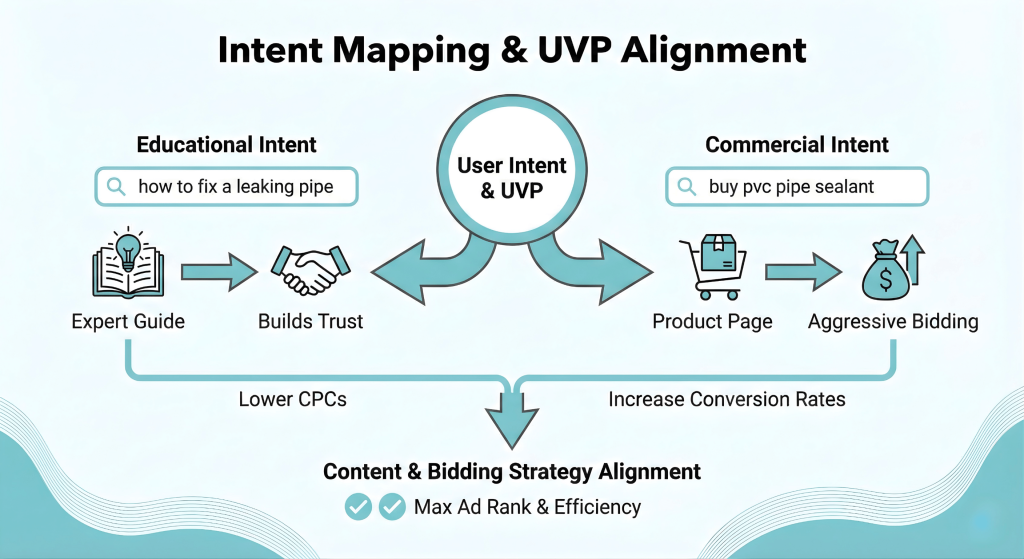
To maximize Ad Rank, your Unique Value Proposition (UVP) must shift from feature-listing to empathy. Stop bidding on keywords if your landing page doesn’t answer the intent behind them.
- Educational Intent: If a user searches “how to fix a leaking pipe,” bid to send them to an expert guide, not a product page. This builds Trust.
- Commercial Intent: If they search “buy pvc pipe sealant,” bid aggressively for the product page.
When your content strategy aligns with your bidding strategy, you lower your CPCs and increase your conversion rates simultaneously.
What is Generative Search?
Generative search is a search engine technology that uses artificial intelligence to create direct answers to user queries instead of just listing web links. It synthesizes information from multiple sources to generate a comprehensive summary that addresses the user’s specific intent. This approach allows users to find complete solutions quickly without needing to click through multiple websites.
As search engines evolve into answer engines, the definition of a winning bid is expanding. With the rise of AI Overviews, the goal is no longer just securing the top blue link; it is becoming the foundational source for the AI-generated summary.
This shift demands a strategy of Answer Engine Optimization (AEO). Bidding algorithms now favor advertisers who provide rich, structured assets: high-resolution images, concise video snippets, and direct textual answers that the AI can easily synthesize. You are essentially bidding to be the key ingredient in the answer the user receives instantly.
This leads to the Zero-Click paradox: overall click volume may decrease as users get immediate answers, but traffic quality increases. The users who do click through after reading an AI summary are no longer in the research phase; they are informed and ready to convert. In this new ecosystem, your bid is not paying for a visit; it is paying to capture a user who has already been pre-qualified by the machine.
Conclusion
The rise of automated bidding does not signal the obsolescence of the advertiser, but their elevation. While algorithms have mastered the math of the auction, they lack the strategic empathy to understand the human why behind the search.
Your role has shifted from manual bid manager to strategic orchestrator. Success now depends on feeding the system high-quality first-party data and crafting creatives that align with user intent. You are no longer competing against the machine; you are partnering with it. By delegating calculation to AI, you are free to focus on strategy, turning the modern search auction into a transparent, scalable engine of profit.
Frequently Asked Questions (F.A.Q.)
How to bid for keywords on Google?
Bidding for keywords is the process of setting your preferences to determine what you are willing to spend for a click or views during a real-time ad auction. In the modern landscape, you no longer bid on literal strings of text but rather use keywords as seeds or anchors for machine learning models. The most effective way to bid is by pairing broad match keywords with Smart Bidding, which allows Google’s AI to evaluate billions of signals, such as device, location, and intent, to place your ad in the right auction at the right price.
What is bidding in simple words?
In simple terms, a bid is the maximum amount of money you are willing to pay for a user to interact with your ad. It acts as a price tag you place on a potential customer’s action, which Google uses alongside your Quality Score to determine if and where your ad appears on the search results page.
What are examples of bidding?
Google Ads offers three primary models:
- Manual Bidding: You manually set the maximum price for each individual keyword.
- Automated Bidding: Google automatically adjusts bids to prioritize volume-based goals like clicks or visibility.
- Smart Bidding: This uses advanced AI to set bids for every individual auction based on the likelihood of a conversion, with strategies such as Target CPA or Maximize Conversion Value.
Can you change your mind after bidding?
Yes, you can adjust your budgets and targets at any time; however, frequent changes can reset the AI’s learning phase, leading to performance swings. For AI-driven features like AI Max, you also have the power to remove specific generated text assets or landing pages that do not align with your brand standards after they have been created.
What are the risks of bidding?
The primary risks include wasting budget on low-intent queries (like “free” or “DIY”) and brand cannibalization, where AI systems accidentally show your ads for competitor terms because they are semantically related. Additionally, many automated strategies act as a black box with limited transparency into why certain bids were placed, and campaigns often experience temporary performance dips during their initial 7-to-14-day learning periods.
What are the 5 steps in the bidding process?
For an effective Value-Based Bidding approach, follow these five essential steps:
- Clarify your objectives by defining what “value” (revenue, profit, or lead quality) means to your business.
- Harness quality first-party data by linking customer identifiers like emails to your offline sales.
- Choose a Smart Bidding strategy that aligns with your specific financial goals.
- Analyze your reports to gain deeper insights into which customers are bringing the most long-term value.
- Optimize continuously by adapting your targets as your business evolves.
What is a good bidding strategy?
A good strategy is one that reflects your specific business goals—whether you want to maximize traffic, lead volume, or revenue. Today, the gold standard is a hybrid approach that uses broad match to capture intent, Smart Bidding to manage the auction, and Responsive Search Ads to ensure the message matches the user’s query.
What are three smart bidding strategies?
Three of the most common Smart Bidding strategies include:
- Target CPA (Cost-Per-Acquisition): Bids to get as many conversions as possible at your set cost target.
- Target ROAS (Return on Ad Spend): Bids to maximize revenue while meeting a specific return percentage.
- Maximize Conversions: Bids to spend your entire budget to get the highest volume of actions possible.
What are two types of value-based smart bidding?
The two advanced types of value-based bidding are Maximize Conversion Value, which prioritizes the total sales value within your budget, and Target ROAS (tROAS), which seeks the most value while maintaining a specific efficiency target. These strategies are superior because they treat high-value repeat customers differently from one-time discount shoppers.
What is the highest value bidding strategy?
Target ROAS (tROAS) is generally considered the highest value bidding strategy. Data shows that advertisers who switch from volume-based targets (like Target CPA) to Target ROAS see a median increase of 14% more conversion value at a similar return on spend.
Author:

Get 3x more revenue from the same ad spend.
Let our onboarding experts show you the power of AI-driven PPC optimization.
Start scaling today
Popular Posts
-
 How Many Keywords Should Be In an Ad Group in Google Ads?
For the vast majority of modern campaigns, the ideal number…
Read more -
 Google Ads Script for Dummies: An Introduction
Imagine you have an e-commerce website that sells licensed superhero…
Read more -
Google Ads Sitelink Character Limits
Your Google Ads are cutting off in the middle of…
Read more -
What Is Conversion Value in Google Ads?
What if you could put a price tag on every…
Read more

Register for our Free 14-day Trial now!
No credit card required, cancel anytime.