Imagine launching a PPC campaign that just dominates. Picture cutting through the noise of digital advertising with laser precision, slashing wasted ad spend, and watching your ROI skyrocket while competitors scramble to keep up. This isn’t a fantasy; it’s the reality for marketers who leverage the right PPC marketing tools in 2026. The digital advertising landscape is evolving at breakneck speed, with AI-driven automation, hyper-targeted audience insights, and real-time bidding strategies reshaping how brands connect with customers. But here’s the catch: without the right tools, even the most seasoned marketers risk drowning in data overload, inefficiencies, and missed opportunities.
Whether you’re a solopreneur stretching a tight budget, an agency juggling multiple client accounts, or an enterprise scaling global campaigns, the tools you choose can make or break your success. This guide isn’t just another list; it’s your definitive roadmap to the most powerful PPC tools of 2026, meticulously researched and battle-tested to help you automate, optimize, and outperform in every campaign. From AI-powered bid management to competitor intelligence that feels like cheating (but isn’t), we’ll dive deep into the features, use cases, and game-changing strategies that separate the leaders from the laggards. Ready to transform your PPC results? Let’s get started.
Essential PPC Tools for Your 2026 Stack
While strategy is the engine, these specific tools are the fuel. Here is a breakdown of the essential software that forms the backbone of a winning PPC strategy in 2026, ranging from native platform essentials to advanced competitive intelligence suites.
1. Adsbot: The AI-Powered Command Center
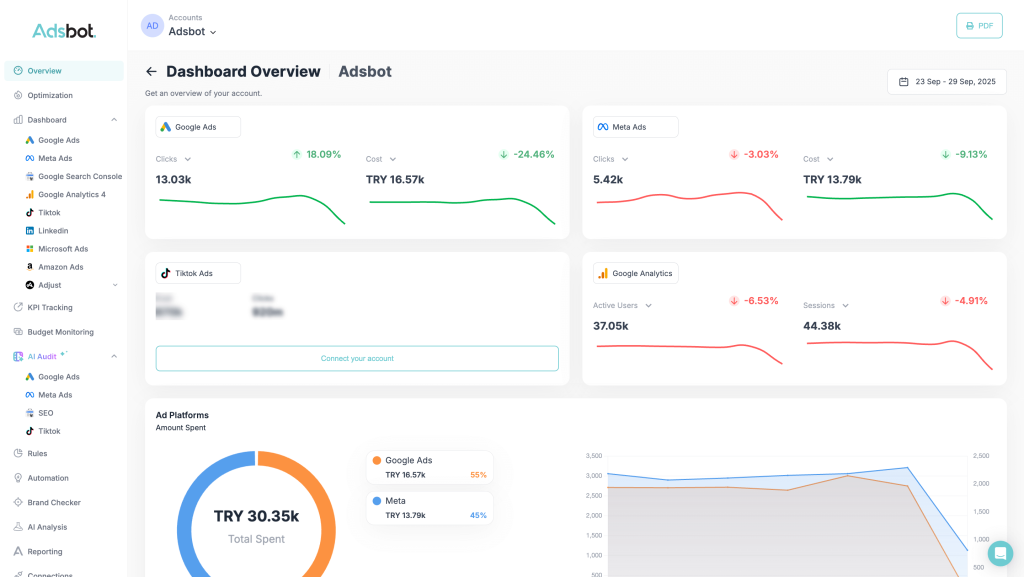
In 2026, efficiency is the name of the game, and Adsbot is the ultimate force multiplier. It goes beyond simple management to function as an autonomous 24/7 digital marketing optimization platform. Designed to handle the heavy lifting for Google Ads, Meta Ads, TikTok Ads, and more, Adsbot is the tool you use when you want to stop staring at spreadsheets and start scaling your strategy.
- Top Features:
- Rule Engine & Automation: Create custom “automation agents” that work while you sleep. Automatically pause non-converting keywords, adjust budgets based on ROAS, or exclude low-performing placements instantly.
- AI Audit: Unlock hidden potential with a single click. The AI Audit analyzes your entire account to identify wasted spend and prioritizes growth opportunities, effectively giving you a roadmap to higher ROI.
- Unified Dashboard & Reporting: Stop tab-switching. Monitor all your KPIs across Google, Meta, and TikTok in one visually intuitive dashboard, and send automated, professional-grade reports to clients or stakeholders.
- 2026 Strategy: Use Adsbot’s One-Click Optimization to handle the daily grind. Let the AI flag and fix underperforming ads and keywords, freeing up your team to focus on creative strategy and big-picture growth.
2. Google Search Console
Don’t let the Search in the name fool you; Google Search Console (GSC) is a sleeper hit for PPC strategists. While its reputation is built on SEO, it provides a critical layer of query-level data that informs paid strategies. It acts as the bridge between organic visibility and paid acquisition.
- Why it matters: It reveals the “invisible” data, queries that trigger impressions but not clicks.
- Top Features:
- Query Synergy: Identify exactly what users type to find you organically to refine your paid match types.
- Landing Page Health: Use URL inspection to ensure the pages you are paying to promote are indexed and mobile-optimized.
- Core Web Vitals: Since page experience impacts Quality Score, GSC’s vitals report is essential for lowering your CPC.
- 2026 Strategy: Export your top-performing organic queries and cross-reference them with your paid keyword list. If you rank organically for a high-intent term but aren’t bidding on it, you are leaving money on the table. Add these to your PPC campaigns to dominate the SERP real estate completely.
3. Semrush
Semrush has evolved far beyond a simple SEO utility into a full-stack digital dominance platform. For PPC specialists, it offers X-ray vision into competitor strategies, allowing you to see not just what rivals are doing, but how much they are spending to do it.
- Why it matters: It removes the guesswork from market research by showing you the blueprints of successful campaigns in your niche.
- Top Features:
- Ad Strategy Decoding: View the exact ad copy, live keywords, and landing page history of your fiercest competitors.
- Keyword Magic: A massive database that clusters keywords by intent, helping you find high-volume, low-competition terms.
- PLA Research: For e-commerce, see exactly which products competitors are pushing in Google Shopping.
- 2026 Strategy: Utilize the “Advertising Research” module to export the top paid keywords of your three biggest rivals. Filter this list for high-volume keywords with lower competition scores—these are your “gap opportunities” where you can outbid rivals without blowing your budget.
4. Google Analytics 4 (GA4)
Clicks are vanity metrics; conversions are sanity. Google Analytics is the non-negotiable hub that connects your ad spend to actual revenue. It tells the story of what happens after the click.
- Why it matters: It provides the attribution data necessary to understand which campaigns are actually driving business growth, not just traffic.
- Top Features:
- Cross-Channel Attribution: Understand how paid ads assist organic or direct conversions across the entire customer journey.
- Granular Audience Building: Create hyper-specific segments based on site behavior (e.g., “Cart Abandoners > $100”) to export directly to Google Ads for remarketing.
- Unified Reporting: Seamless integration means your Google Ads cost data lives right alongside your revenue data.
- 2026 Strategy: Build a custom PPC Quality dashboard. Don’t just look at conversion rates; track “Pages per Session” and “Engagement Time” segmented by campaign. This reveals which ads bring in window shoppers and which bring in buyers, allowing you to optimize for quality over quantity.
5. Google Keyword Planner
When you need raw data straight from the source, Google Keyword Planner remains the gold standard. It is the only tool that gives you data directly from Google’s massive query stream, making it indispensable for forecasting and budgeting.
- Why it matters: It offers the most accurate bid estimates and search volume forecasts because the data comes directly from the auction house itself.
- Top Features:
- Budget Forecasting: accurately predict clicks, impressions, and required spend based on your specific location and bid strategy.
- Bid Estimates: View “Top of Page” low and high range bids to understand the financial barrier to entry for specific terms.
- Local Nuance: Drill down search volume to the city or region level for hyper-local campaigns.
- 2026 Strategy: Look for the “Low Competition” gems. A keyword like “dental expert marketing” might have high volume but exorbitant CPCs. Conversely, “dental marketing certification courses” might have lower volume but significantly lower competition and higher intent. Use the planner to find these high-ROI pockets.
6. Ahrefs
While famous for backlinks, Ahrefs has quietly built one of the most robust keyword intelligence tools on the market. It excels at showing the “Click” reality versus the “Search Volume” fantasy.
- Why it matters: It helps you distinguish between keywords people search for and keywords people actually click on.
- Top Features:
- Clicks vs. Volume: See the percentage of searches that result in a click (vs. zero-click searches), saving you from bidding on dead-end terms.
- Content Gap Analysis: Instantly identify valuable keywords your competitors are ranking for (paid or organic) that you are missing.
- Parent Topics: It automatically groups similar keywords, helping you structure your ad groups around broad topics rather than fragmented terms.
- 2026 Strategy: Use the “Parent Topic” feature to consolidate your ad groups. Instead of creating ten different ad groups for slight variations of a phrase, identify the core parent topic and create one highly relevant, high-quality ad group that captures all the variations.
7. Google Trends: The Pulse of the Market
Timing is everything in PPC. Google Trends is your radar for seasonality, viral spikes, and shifting consumer interests before they show up in standard keyword tools.
- Why it matters: It allows you to be proactive rather than reactive, capitalizing on rising interest before the CPCs skyrocket.
- Top Features:
- Temporal Shifts: Visualize interest over time to pinpoint exactly when seasonal demand begins to ramp up.
- Geographic Heatmaps: See where in the world (or country) interest is hottest to adjust your location bid modifiers.
- Comparative Analysis: Pit up to five search terms against each other to see which brand or product category is winning the mindshare war.
- 2026 Strategy: Don’t wait for the peak. Use Trends to identify the historical start date of seasonal interest for your product. Start ramping up your bids and warming up your audiences 2–3 weeks before the spike. You’ll capture early adopters at a lower CPC while your competitors are still asleep at the wheel.
What Are PPC Marketing Tools and How Do They Work?
PPC (Pay-Per-Click) marketing tools are specialized software platforms designed to streamline, automate, and enhance every facet of paid advertising campaigns across search engines, social media, and display networks. At their core, these tools act as a force multiplier for marketers, enabling them to manage bids, target audiences, analyze performance, and optimize ads with precision that manual processes simply can’t match. Think of them as the command center for your advertising efforts: they aggregate data from platforms like Google Ads, Microsoft Advertising, and Meta Ads, then apply advanced algorithms to identify patterns, predict trends, and execute adjustments in real time. For example, a tool might automatically pause underperforming keywords at 2 AM when conversion rates dip, or dynamically adjust bids based on real-time performance data, tasks that would take humans hours to monitor and act upon.
The mechanics behind these tools vary, but most operate through a combination of API integrations, machine learning, and proprietary databases. When you connect a PPC tool to your ad accounts, it pulls in historical and live data, click-through rates (CTR), cost-per-click (CPC), conversion metrics, and more, then cross-references this with external signals like competitor activity. Advanced tools leverage predictive analytics to forecast which keywords or audiences will yield the highest ROI, while others focus on automation scripts to handle repetitive tasks like A/B testing ad copy or rotating creative assets. The result? Campaigns that aren’t just managed but continuously optimized for maximum efficiency, freeing marketers to focus on strategy rather than spreadsheets. Without these tools, modern PPC would be akin to flying a plane blindfolded, possible, but wildly inefficient and risky. Furthermore, advanced analytics help clarify the difference between PPC and CPC to ensure precise budget tracking.
Key Features to Look for in PPC Marketing Tools
The single most critical feature in any PPC marketing tool is its ability to deliver actionable, real-time insights through seamless data integration across all your advertising platforms. A tool that siloes data or requires manual uploads will slow you down, introduce errors, and blind you to opportunities. Look for solutions with native API connections to Google Ads, Microsoft Advertising, Meta, TikTok, and other key networks, ensuring your dashboards reflect live performance metrics without delays. This foundational capability enables everything else, from automation to reporting, so prioritize tools that act as a unified hub for all your PPC data. Other key factors include:
- 24/7 Performance Monitoring and Alerts: Continuous, around-the-clock monitoring of your accounts that provides real-time alerts on any significant changes, anomalies, or issues like broken URLs, ensuring you’re always informed.
- Rule-Based Campaign Optimization: A powerful Rule Engine that allows you to set up custom automated rules from a library of predefined tasks to perform actions or send alerts based on your specific criteria, bringing full automation control to your campaigns.
- Competitor Intelligence: Features that track specific keywords (like your brand or competitors’ names) and notify you which advertisers’ ads appear for those queries. This allows you to see if competitors are bidding on your terms and “spy” on their ad copies, titles, and keywords.
- Budget and Bid Management: Tools to track spending against your budgets, send alerts for pacing issues, and recommend adjustments. This includes rule-based automation to modify bids and budgets based on performance triggers.
- Real-Time Multi-Channel Dashboard: A unified interface that aggregates performance metrics from multiple sources (Google Ads, Google Analytics 4, Meta Ads, TikTok Ads, etc.) in real-time for a comprehensive view of all your campaigns.
- Automated Reporting: The ability to automatically generate easy-to-read reports with actionable insights on your campaign performance, eliminating manual data gathering and allowing for scheduled reports to be sent via email.
Ultimately, the best PPC tools don’t stop at just providing features; they also solve problems. For agencies, that might mean multi-account management with role-based permissions; for e-commerce brands, it could be deep integrations to monitor landing page speed and health. Always align features with your specific pain points, and don’t overlook scalability; a tool that works for a $10K/month budget may crumble under $100K in spend. Test drive free trials or demos to ensure the interface is intuitive for your team, as even the most powerful tool is useless if no one uses it.
Top PPC Tools for Keyword Research and Competitor Analysis
Keyword research and competitor analysis form the bedrock of any high-performing PPC campaign, and the tools in this category have evolved from simple keyword generators to sophisticated intelligence platforms that uncover hidden opportunities and threats. Leading the pack in 2026 is SEMrush, which combines a massive keyword database with AI-powered recommendations to identify high-intent, low-competition terms. Its Keyword Magic Tool clusters keywords by intent and predicts their performance, while the Ad History feature lets you see a competitor’s past ads. For enterprises, some tools offer deep backlink and SERP analysis.
For those focused on Google Ads dominance, Adsbot stands out by reverse-engineering competitors’ entire PPC strategies. Its Brand Checker tracks which advertisers appear for your brand or competitor keywords and lets you review their ad copies, titles, and URLs. This gives you invaluable insights into their advertising strategy and helps you identify if competitors are bidding on your terms. This feature is a powerful resource for expanding your reach and protecting your brand presence.
What sets these tools apart in 2026 is their predictive capabilities and automation. For example, Adsbot’s Rule Engine can be set up to send alerts when competitors start bidding on your branded terms, a tactic that can erode your market share if left unchecked. The key is to layer these tools: use one for broad keyword discovery (like SEMrush), and another for deep competitor tracking and ongoing monitoring (Adsbot). This ensures you’re not just reacting to the market but anticipating it.
Automation Solutions in PPC Marketing Tools
Automation in PPC marketing tools has transcended basic rule-based triggers to become the central nervous system of high-efficiency campaigns, handling everything from bid adjustments to performance alerts with minimal human intervention. At the forefront are smart bidding algorithms, like those in Google’s Performance Max or Meta’s Advantage+, which dynamically allocate budget across channels based on real-time conversion likelihood. These systems learn from thousands of signals to predict which users are most likely to convert and adjust bids accordingly.
You can also improve your results by utilizing PPC keyword optimization tools.
Beyond bidding, automation extends to account management and optimization. Tools like Adsbot use automation that lets you set up custom automation agents to perform actions based on your criteria. For example, its “One-Click Optimizations” can scan your account for potential improvements (e.g., pausing low-CTR keywords, adding negative keywords) and apply them with a single click, saving hours of manual work. For agencies, Adsbot takes this further with multi-account management, allowing them to oversee all client accounts from one dashboard.
The most advanced tools now offer “autonomous campaign management”, where AI doesn’t just assist but fully pilots aspects of your PPC strategy. Adsbot, for example, automatically adjusts budgets, pauses underperforming ads, and even suggests new keywords based on performance data, all while sending you alerts and reports. Its platform uses deep learning to predict which combinations of keywords, ads, and landing pages will yield the highest ROI, then reallocates budget accordingly. The caveat? Automation is only as good as the data it’s trained on. Always audit automated changes initially to ensure they align with your goals, and use tools that offer transparent reporting on why decisions were made.
The Role of AI in Modern PPC Marketing Tools
Artificial intelligence has shifted from a buzzword to the backbone of PPC marketing tools, transforming how campaigns are built, managed, and optimized. At its core, AI in PPC acts as a force multiplier, processing vast datasets, click patterns, conversion paths, and competitor moves at speeds impossible for humans, then extracting actionable insights. For instance, Google’s AI-powered Smart Bidding analyzes trillions of search queries to predict which auctions are worth entering, adjusting bids in real time to maximize conversions or revenue. Similarly, Meta’s AI now dynamically generates ad creative by combining your assets in ways proven to resonate with specific audience segments.
Beyond optimization, AI is revolutionizing audience targeting and account monitoring. Tools like Adsbot use AI to analyze performance data and generate smart insights and recommendations, acting as an AI-powered “digital marketing assistant.” It continuously monitors your accounts 24/7 for any significant changes or issues, providing real-time alerts so you’re always informed. For example, if Adsbot detects a sudden drop in conversions or a spike in CPC, it will immediately notify you.
The most cutting-edge applications of AI in PPC are predictive and prescriptive. Adsbot’s AI doesn’t just tell you which keywords are underperforming; it simulates the impact of pausing them or adjusting match types, so you can preview outcomes before making changes. Similarly, Adsbot can forecast budget needs based on historical performance, ensuring you never overspend or miss opportunities. However, AI isn’t infallible. The best tools provide “explainable AI” features, showing you the logic behind recommendations (e.g., “Bid decreased due to a 30% drop in conversion rate for this keyword over the past 7 days”). As AI continues to evolve, the tools that will dominate are those that balance automation with human oversight, allowing marketers to focus on strategy while AI handles execution.
Common Challenges in PPC Marketing and How Tools Can Help
The most pervasive challenge in PPC marketing is the sheer complexity of managing cross-channel campaigns while maintaining profitability. With consumers jumping between Google, Meta, TikTok, and other networks, tracking performance and attributing conversions accurately can be difficult. Tools like Adsbot address this by unifying data from all platforms into a single real-time multi-channel dashboard. Meanwhile, Adsbot’s automation lets you set automated cross-channel agents, like reducing bids on Facebook if Google Ads CPA spikes, ensuring your budget flows to the highest-performing channels. Other key challenges include:
- Keyword Bloat and Wasted Spend: Many accounts suffer from underperforming keywords that drain the budget. Tools like Adsbot automatically identify and pause low-ROI keywords, while its Duplicate Keyword Remover helps eliminate internal competition.
- Ad Fatigue and Creative Burnout: When ads run too long, CTR plummets. While some tools generate new creative, Adsbot monitors ad performance and alerts you when metrics decline, so you know when it’s time to refresh your creative.
- Competitor Poaching: Rivals bidding on your branded terms can hijack your traffic. Adsbot’s Brand Monitoring alerts you to these attacks and allows you to “spy” on their ad copy and strategy to inform your counter-moves.
- Budget Allocation Inefficiencies: Without dynamic budgeting, you risk overspending on low-intent keywords. Adsbot’s budget tracking tool reallocates funds based on conversion probability and alerts you to campaigns that are limited by budget.
- Compliance and Broken Links: Ads getting disapproved or leading to broken pages waste money. Adsbot’s URL Checker immediately alerts you if any ad’s destination URL is broken or returning an error, helping you avoid wasting money on ads that lead to dead pages.
The right tools don’t just mitigate these challenges; they turn them into advantages. For example, competitor intelligence tools like Adsbot transform the threat of rival campaigns into an opportunity to outmaneuver them. Similarly, automation platforms like Adsbot reduce the risk of human error in bid management, ensuring your campaigns run like well-oiled machines. The key is to integrate tools that cover the full spectrum of challenges, from data unification to creative optimization, so you’re not just putting out fires but building a resilient, high-performing PPC engine. Start by auditing your biggest pain points, then select tools that address them directly.
Author:

Get 3x more revenue from the same ad spend.
Let our onboarding experts show you the power of AI-driven PPC optimization.
Start scaling today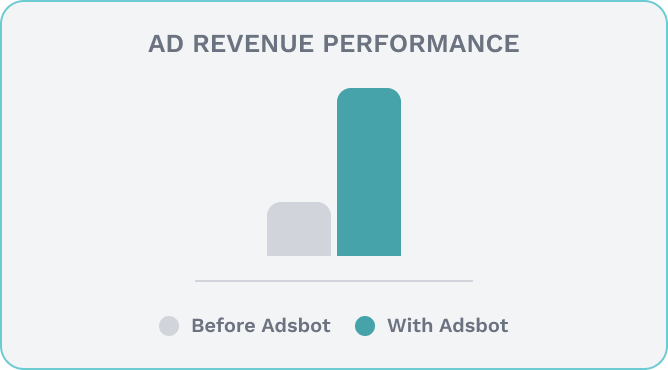
Popular Posts
-
 How Many Keywords Should Be In an Ad Group in Google Ads?
For the vast majority of modern campaigns, the ideal number…
Read more -
 Google Ads Script for Dummies: An Introduction
Imagine you have an e-commerce website that sells licensed superhero…
Read more -
Google Ads Sitelink Character Limits
Your Google Ads are cutting off in the middle of…
Read more -
What Is Conversion Value in Google Ads?
What if you could put a price tag on every…
Read more

Register for our Free 14-day Trial now!
No credit card required, cancel anytime.