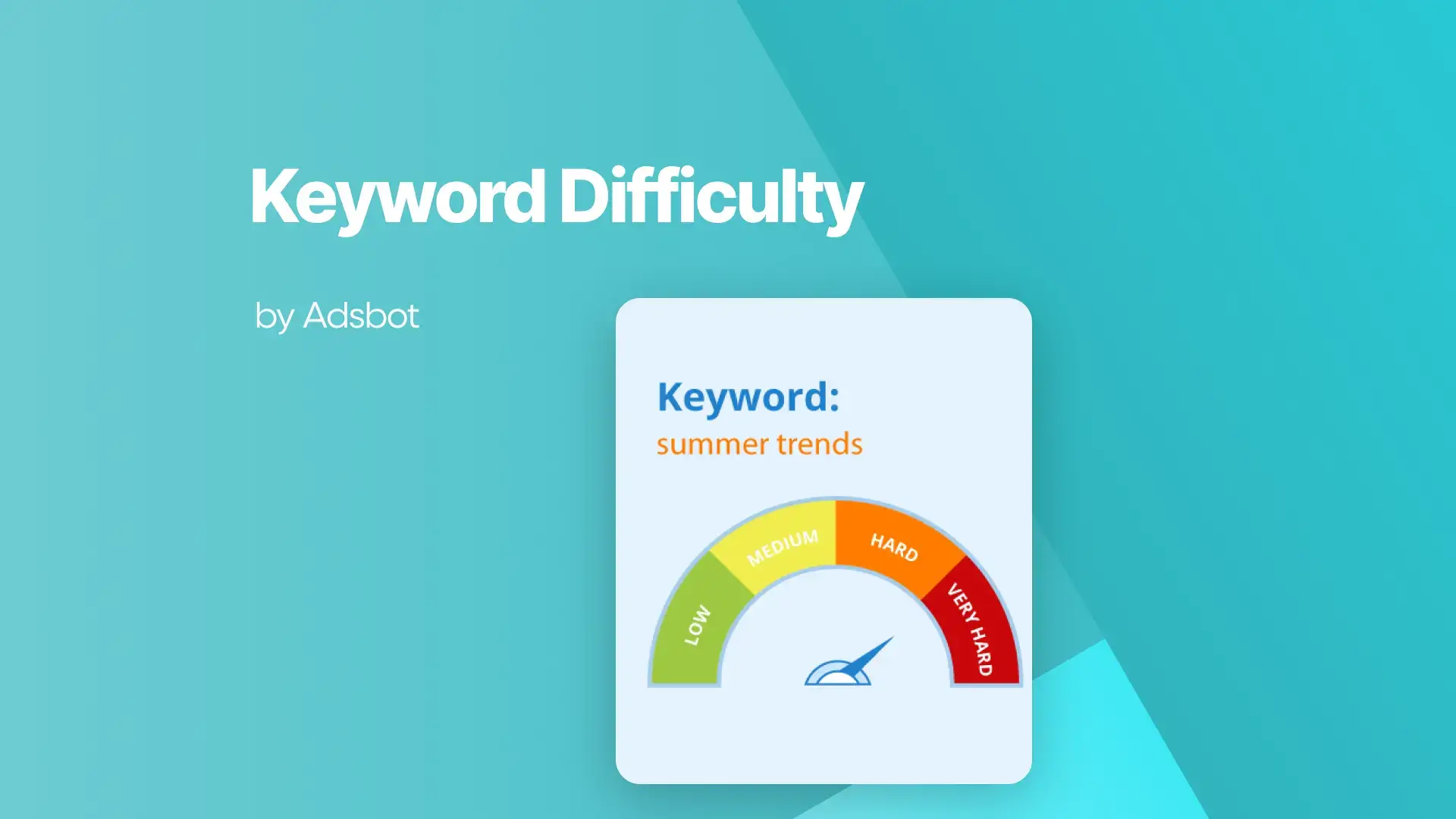
Why Is Traditional Keyword Difficulty No Longer an Accurate Predictor of Traffic?
Traditional keyword difficulty metrics, based primarily on backlink profiles and search volume, have lost predictive power in the age of semantic search. The landscape has shifted from lexical string matching to Entity Relevance Difficulty, where algorithms evaluate a brand’s holistic Topical Authority and the conceptual completeness of a content ecosystem rather than isolated page metrics.
Entity Relevance Difficulty
We have observed a fundamental disconnect in modern SEO tools. While standard advice in The Google Ads Keyword Guide is valuable for ads, organic tools still calculate difficulty based on how many links a URL has, but Google and LLMs calculate rank based on how well a brand covers a conceptual space. This is Entity Relevance Difficulty. If your site lacks the semantic support structures, related entities, attributes, and sub-topics, you will not rank, regardless of your domain authority.
The Reality of Zero-Click Search
The definition of traffic has changed. Our data indicates that approximately 58% to 60% of searches now end without a click to an external website. Ranking for a high-volume definition keyword is often a trap. You capture the impression, but the user satisfies their intent immediately on the SERP. These rankings are vanity metrics that inflate reports but do not drive revenue.
Intention vs. Matching
AI operates on semantic meaning rather than phrase matching. We consistently find that traditional tools have a 40–60% error margin in estimating traffic in AI-first environments. A tool might show low difficulty for a phrase, but if the intent requires a visual answer or a verified human perspective, the actual difficulty to compete is astronomical.
Information Gain as a Ranking Factor
Algorithms now prioritize Information Gain, unique data that does not exist in other top-ranking results. Regurgitating the consensus view is no longer a safe strategy. To compete, we must inject proprietary data or unique angles that force the LLM to cite us as a primary source.
In Our Analysis: The Value of Zero Volume
We argue that Zero Volume keywords are actually the highest value targets today. Chasing high-volume, medium difficulty keywords often leads to vanity traffic, users who get their answer from the SERP and never click. Real SEO strategy now involves targeting queries where the AI cannot provide a sufficient answer without a click, such as nuanced human experience.
How Do AI Overviews and Agentic Search Alter the Competitive Landscape?
AI Overviews create a visibility squeeze by pushing organic results below the fold, particularly for informational queries. Competition has shifted from ranking #1 to earning a citation within the AI snapshot. While AIOs reduce overall click-through rates, the traffic that remains is often higher quality, showing lower bounce rates and deeper engagement because the user has been pre-qualified by the AI summary.
The Saturation of AI Overviews
AI Overviews (AIO) appear in approximately 16% of all search queries. However, this number is misleadingly low. When we isolate long informational queries exceeding seven words, that figure jumps to 65.9%. If your strategy relies on answering complex questions, you are competing directly with the engine itself.
The Quality Paradox
There is a silver lining in the data. Users clicking through from AI-enhanced results show a 23% lower bounce rate and spend 41% more time on site. The AI acts as a filter, removing low-intent users. The traffic you lose is often the traffic you didn’t want, while the users who click are seeking depth that a summary cannot provide.
Citation Share vs. Market Share
The new metric replacing rankings is Citation Share. Our testing shows that appearing as a cited source can increase CTR from 0.6% to 1.08% compared to standard results. The goal is no longer just to rank blue links but to be the source of truth that the AI references to validate its output.
The Rise of Navigational Intent
Navigational queries triggering AIOs have skyrocketed from 0.74% to 10.33%, indicating the traffic mix of Branded Vs Non Branded Keywords is increasingly intermediated by AI. Users are searching for brands + specific problems, and the AI provides the synthesis. This means your brand authority directly impacts your visibility in generic searches.
Strategic Insight: The AIO Tax
We call this the SGE/AIO Tax. If you operate in a Health or Tech vertical, where AIO saturation is high, around 51.6% and 17.92% respectively, your content strategy must shift. We advise pivoting away from definitions, which AI eats, to commentary and data, which AI cites. You cannot out-define a machine, but you can out-opinion it.
Which New Metrics Should Replace Standard Keyword Difficulty?
Advertisers and SEOs must move beyond generic difficulty scores toward Personal Keyword Difficulty (PKD) and AI Visibility. Generic scores fail to account for a specific domain’s topical authority. Modern success is measured by Share of Voice within LLM answers and the ability to capture commercial intent queries, which are less likely to be fully satisfied by a summary than top-of-funnel informational queries.
The Fallacy of Generic Difficulty
Standard metrics like KD% are aggregations that ignore your site’s specific context. We prioritize Personal Keyword Difficulty (PKD). This metric asks: Given our current topical authority and content graph, how hard is it for US to rank? A keyword might be Hard for a generalist site but Easy for a specialist brand that already covers 90% of the semantic entity. If you have the supporting cluster, the difficulty drops significantly.
Commercial Intent Arbitrage
We advise a strict pivot away from high-volume informational queries. The real value lies in Commercial Intent, focusing on Bottom Of Funnel Keywords related to pricing, reviews, comparisons, or implementation. These queries are hazard zones for AI due to hallucination risks, meaning Google is more likely to show human-authored links. While a tool might show these as low volume, the conversion intent makes them far more valuable than a definition keyword with 10x the traffic.
Tracking AI Visibility
Ranking #1 in the blue links is no longer the sole KPI. We now track AI Visibility, specifically, “Are we being cited in ChatGPT, Perplexity, or Google’s AIO?” This requires monitoring brand mentions and Share of Citation. If an LLM synthesizes an answer about your industry, your brand must be one of the named entities it retrieves.
In Our Analysis: The Problem-First Audit
Forget the keyword research tool for a moment. We start our strategy sessions by analyzing Customer Support Tickets and Reddit Threads. This is where we find the unpolished jewels, specific, natural language phrasing of user problems. These phrases often show 0 volume in tools because they are too specific, but they represent the highest urgency. We recently saw a client capture a dedicated audience simply by answering a specific error code query that no competitor deemed difficult enough to target.
How Can Content Be Structured to Overcome Entity Relevance Difficulty?
To bypass high difficulty, content must be optimized for Generative Engine Optimization (GEO). This involves structuring data for machine readability using Schema markup and answer-first formatting. The goal is to make content modular and extractable, ensuring AI systems can easily parse facts, statistics, and definitions to construct their answers, thereby earning the site a citation as a trusted entity.
Schema as the Translator
We cannot overstate the importance of Schema Markup (JSON-LD). It is the language that translates your content into entities the machine understands. By explicitly defining the About and Mentions properties in your schema, you connect your content to the broader Knowledge Graph. This is how you tell the AI, “We are an authority on this specific entity,” which is a primary lever in overcoming relevance difficulty.
The Answer-First Architecture
To win the citation, you must serve the answer on a platter. We implement an Answer-First Structure, placing the direct answer, definition, or summary within the first 30–50 words of a section. This facilitates extraction. If an AI has to parse five paragraphs of fluff to find the core data point, it will skip you for a source that is more concise.
Optimizing for RAG
Retrieval-Augmented Generation (RAG) systems look for relevant snippets to synthesize. We structure content into self-contained Content Chunks. Each H2 or H3 section should stand alone semantically. This modularity allows a RAG system to pull a single paragraph to answer a specific user query without needing to process the entire document context.
Tactical Advice: The Human-Amplified Approach
There is a danger in over-optimizing. We have seen sites strip away all personality to please the bot, only to lose the human reader. The winning formula is Human-Amplified AI. We use AI tools to structure the schema and outline the entities, but the actual writing, the Experience in E-E-A-T, must come from a subject matter expert. An LLM can define a strategy; it cannot recount the time that strategy failed and cost you $10,000. That story is your competitive moat.
How Do Topic Clusters and the Long Tail Lower Effective Difficulty?
The Long Long Tail strategy lowers effective difficulty by targeting specific, nuanced sub-intents where a brand can demonstrate absolute completeness. By building a Content Ecosystem of interconnected assets, pillar pages linked to satellite cluster content, brands signal deep topical authority. This reduces the friction of ranking for head terms because the AI recognizes the site as a comprehensive node in the knowledge graph, not just a keyword container.
The Power of the Cluster
Ranking for a high-difficulty head term is rarely about the strength of that single page. It is about the supporting cast. We utilize a hub-and-spoke model where a central pillar is supported by 10–20 cluster pages. This internal linking structure signals to the algorithm that we cover every facet of the topic, making us the logical choice for a citation.
Zero-Shot Attribution
We structure content for Zero-Shot Attribution. This means organizing data in clear lists, tables, and structured data formats so LLMs can retrieve and cite the information without needing extensive retraining. When you make your data machine-readable, you lower the barrier for the AI to choose you as a source.
Information Gain vs. Consensus
To lower difficulty, you must offer Information Gain. If you write what everyone else has written, the AI can summarize the consensus without citing you. We focus on adding proprietary data, original case studies, or contrarian viewpoints. This differentiation forces the engine to reference your specific contribution to the topic.
The Ultimate Hack: Brand Authority
In a Post-Keyword Paradigm, the ultimate hack for Keyword Difficulty is Brand Authority. When a user specifically searches for [Brand Name] + [Topic], keyword difficulty becomes irrelevant. This Navigational Intent is the holy grail. Our long-term SEO play is actually a Brand play, becoming the entity that is the answer, rather than just a page that has the answer.
Conclusion: The Post-Keyword Reality
The era of chasing green easy scores in keyword tools is effectively over. The modern search engine does not match strings; it understands entities. Success now belongs to those who build Authority, not just pages. By focusing on Personal Keyword Difficulty, leveraging Commercial Intent, and optimizing for Generative Engines, you move your strategy from a game of chance to a game of precision.
We are no longer just optimizing for a click; we are optimizing for a citation. The goal is to build a content ecosystem so robust and so distinct that the AI cannot construct a complete answer without referencing you as the source of truth.
Author:

Get 3x more revenue from the same ad spend.
Let our onboarding experts show you the power of AI-driven PPC optimization.
Start scaling today
Popular Posts
-
 How Many Keywords Should Be In an Ad Group in Google Ads?
For the vast majority of modern campaigns, the ideal number…
Read more -
 Google Ads Script for Dummies: An Introduction
Imagine you have an e-commerce website that sells licensed superhero…
Read more -
Google Ads Sitelink Character Limits
Your Google Ads are cutting off in the middle of…
Read more -
What Is Conversion Value in Google Ads?
What if you could put a price tag on every…
Read more

Register for our Free 14-day Trial now!
No credit card required, cancel anytime.